





Blog
Family Coloring Time: How It Strengthens Parent-Child Bonds
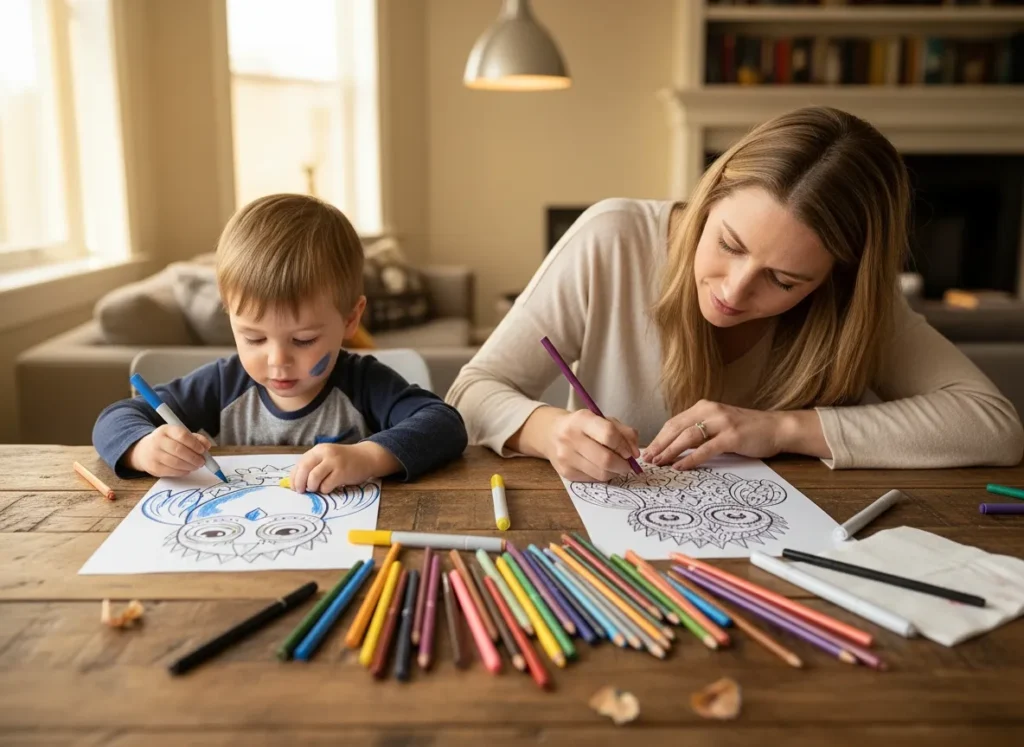
Discover how family colouring time builds emotional bonds between parents and children, with age-specific tips, tool guidance, and printable PDF ideas for beginners.
Most parents think family coloring time is about staying inside the lines. That misunderstanding changes everything, because the moment a parent corrects a child’s color choice or redirects a crayon, the activity stops being a bonding experience and becomes a performance. The real mechanism behind emotional connection during coloring is not precision. It is parallel presence: two people working on the same task, at the same table, without an agenda attached to the outcome. This article covers the real developmental benefits of regular coloring for children aged three to ten, how a single page can hold a child’s attention far longer than most parents expect, how adults and children can share the same pages differently, and which tools actually match each age group’s physical development.
The real benefits of regular coloring for children ages 3 to 10
The bond that builds during a coloring session does not come from the coloring itself; it comes from the sustained, low-pressure co-presence that the activity creates. When a parent sits beside a child without evaluating the result, the child’s nervous system registers safety. That registration is the foundation of secure attachment, and it happens below the level of conscious conversation.
The benefits of how does family coloring time help strengthen emotional bonds between parents and children? for children are both relational and developmental. On the developmental side, regular coloring builds grip endurance, pressure control, and visual tracking. These are the same physical skills that handwriting requires. A child who colors three times a week arrives at writing tasks with a measurably better-prepared hand than one who does not.
On the relational side, the benefit is more specific than most guides acknowledge. Children aged three to seven are still learning to read adult emotional states. Sitting beside a parent who is genuinely engaged in their own page, not supervising, not evaluating, gives the child a rare experience: undivided adult attention directed at a shared object rather than at the child’s behavior. That experience, repeated regularly, builds trust in a way that structured play rarely does.
A concrete example: a five-year-old who colors beside a parent for twenty minutes three times a week will initiate conversation during those sessions that they do not initiate elsewhere. The task absorbs enough attention to lower the child’s social guard, and real communication follows.
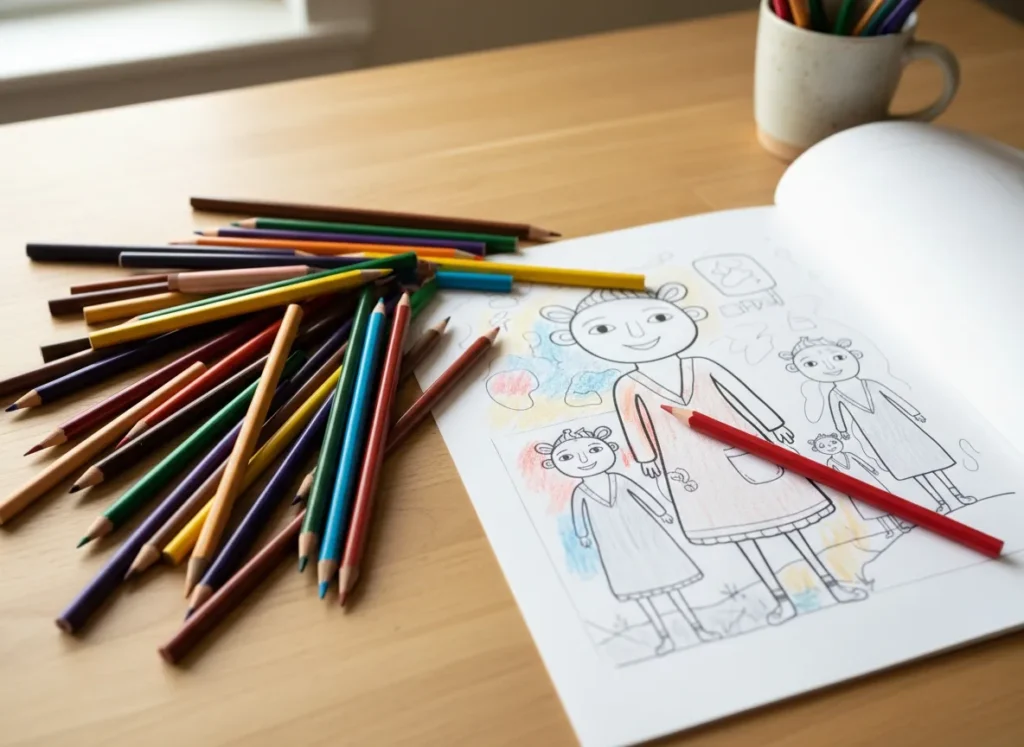
How a single coloring page can hold a child’s attention for forty minutes during family coloring time
A child stays on a coloring page for forty minutes when the page is matched correctly to their current skill level, not when it is the most beautiful or the most detailed page available. This is the variable most parents and family colouring time guide resources miss entirely.
The mechanism is simple. A page that is too simple produces boredom within five minutes because the brain disengages once it stops being asked to make decisions. A page that is too complex produces frustration within the same window because the brain encounters demands it cannot yet meet. The productive zone sits between those two points: a page with enough achievable complexity to keep decision-making active without triggering the frustration response.
For children aged three to five, that zone means thick outlines, large single-color areas, and a recognizable subject. For children aged six to ten, it means some interior linework and moderate interior detail. The best how does family coloring time help strengthen emotional bonds between parents and children? for kids ages 3 to 10 are not the most intricate pages in a collection. They are the pages that sit just above the child’s current comfort level.
When the page is correctly matched, sustained attention is not something a parent needs to encourage. It is the natural result of a task the brain finds appropriately challenging. A seven-year-old given a well-matched page will often remain at the table past the point where a parent expects them to drift, simply because the next decision, which space to fill, which color to choose, continues to arrive at a rate the brain finds engaging.

How parents and children can color the same pages differently
One of the most underused features of a well-designed coloring collection is that the same page can offer a genuinely different experience to a five-year-old and a thirty-five-year-old working side by side. This is what makes family coloring time function as a shared activity rather than a supervised one.
A child working on broad areas with a crayon is making fast, high-visibility progress. An adult working on the same page with colored pencils is layering, blending, and attending to fine detail. Both experiences are satisfying on their own terms. Neither person needs to slow down for the other, and neither feels that they are participating in a lesser version of the activity.
The how to how does family coloring time help strengthen emotional bonds between parents and children? at home question resolves practically when the parent treats their own page as a genuine creative task rather than a demonstration. A parent who is actually engaged in their own work produces a fundamentally different session than a parent who is half-watching the child while pretending to color. Children perceive the difference immediately, and the quality of the co-presence changes accordingly.
A printable PDF series designed for family use should include this layered experience within every page: broad areas for young children working with crayons, and sufficient interior detail to engage an adult working with pencils. When both are present, the session runs without negotiation, without boredom, and without the dynamic of one participant waiting for the other to finish.
How to choose the right coloring tools for each age group to maximize family coloring time
The tool a child uses determines not just the visual result but whether they stay at the table at all, and the wrong tool produces frustration that gets attributed to the child’s attention span rather than the material mismatch. This is one of the most practical family colouring time tips for parents available, and it costs nothing to apply.
For children aged three to five, wide-tipped crayons are the correct tool. The wide barrel supports the fist grip that is developmentally normal at this age, and the broad tip covers large areas quickly, which produces the visible progress that keeps a young child motivated. Thin crayons and standard colored pencils require a tripod grip that most children under five have not yet developed, and they produce lighter marks that feel unrewarding.
For children aged six to ten, colored pencils become the better choice because they allow layering and correction. A child who makes a color decision they want to change can work over it with a second pencil, which keeps the page recoverable and the child emotionally invested. Markers work well for this age group as a secondary tool for bold outlines or background areas, but not as a primary tool on detailed pages because the ink commits on contact and removes the child’s ability to adjust.
The how does family coloring time help strengthen emotional bonds between parents and children? ideas for beginners that produce the most consistent results always start with tool matching before page selection, because a correctly matched tool removes the most common point of friction before the session begins.
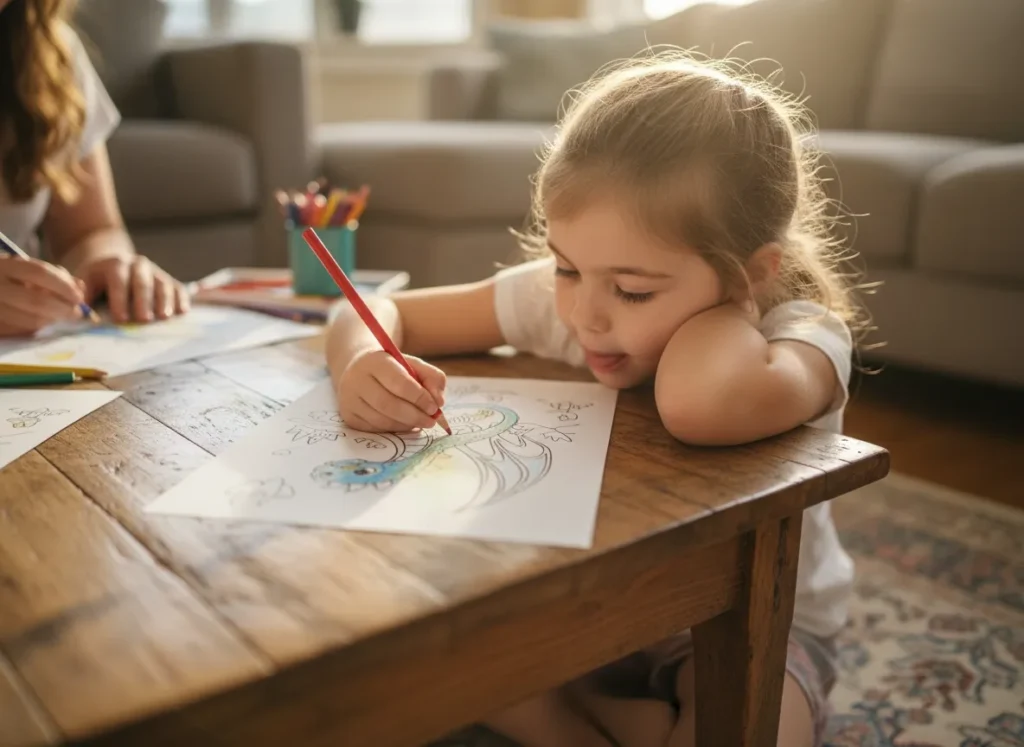
Frequently asked questions about How does family coloring time help strengthen emotional bonds between parents and children?
Is coloring actually beneficial for children?
Yes, and the benefit is more specific than most parents realize. Coloring within defined boundaries requires the brain to coordinate visual input with fine motor output simultaneously, which strengthens the neural pathways associated with both focus and hand control. For children aged three to seven, this coordination is still developing, which means regular coloring practice produces measurable gains in grip endurance and pencil pressure control. These gains transfer directly to writing readiness, which is why occupational therapists frequently include structured coloring in fine motor development programs.
At what age should children start coloring?
Children can begin with broad crayons and simple shapes as early as eighteen months, though intentional coloring within defined lines typically develops around age three or four. For the kind of shared, detail-oriented coloring that produces the relational benefits described in this article, age three is a reasonable starting point with appropriately simple pages. By age five, most children can sustain focused work on a single page for fifteen to twenty minutes, and by age seven, that window extends to thirty minutes or more when the page complexity is correctly matched.
How long should a coloring session last?
For children aged three to five, fifteen to twenty minutes is the productive range. For children aged six to ten, twenty to forty minutes is realistic when the page is well-matched to their skill level. The key principle is ending the session while the child is still engaged rather than waiting until attention drifts. Sessions that end on a note of completion and satisfaction are significantly more likely to be requested again by the child, which is what builds the regular habit that produces the relational benefits over time.
What coloring tools are best for young children?
Wide-tipped crayons are the best starting tool for children under six because the barrel diameter supports the fist grip that is developmentally appropriate at this age. Triangular crayons are particularly useful because the shape naturally guides the fingers toward a more functional grip position without instruction. For children aged six and above, a set of twelve to twenty-four colored pencils with a slightly soft core provides the layering capability and correction flexibility that detailed pages require. Washable markers work well as a secondary tool at any age but should not replace pencils on detailed pages because the ink cannot be corrected once applied.
Can adults benefit from coloring too?
Adults benefit from coloring in ways that are distinct from children’s benefits. The primary effect for adults is the restoration of single-task focus, which is increasingly rare in a daily environment saturated with partial-attention demands. Completing even a small section of a complex coloring page requires sustained attention directed at one physical object, which produces a measurable reduction in the cognitive load that accumulates across a normal day. Adults who color alongside their children also consistently report that the shared activity creates natural, unforced conversation, particularly with children approaching adolescence, when structured activities tend to produce better conversation than direct questions.
Family coloring time works because it creates parallel presence without performance pressure. The child is not being evaluated, the parent is not supervising, and neither participant is waiting for the other. That combination is rarer in modern family life than most parents realize, and its effect on the parent-child relationship compounds over time. The right pages, the right tools, and a consistent weekly habit are all that is needed to make the activity function at the level this article describes.
Every week spent without a consistent coloring routine is a week where the conditions for that kind of unforced connection are harder to create. The Cozy Family Coloring Book PDF series contains pages designed for exactly the shared, multi-age experience described here, and the collection is available to download now. Waiting means the next opportunity to build that habit passes without the right materials in place.
